
Nobody Has the Map for AI
Why everyone sounds certain about AI even when nobody knows where it’s going

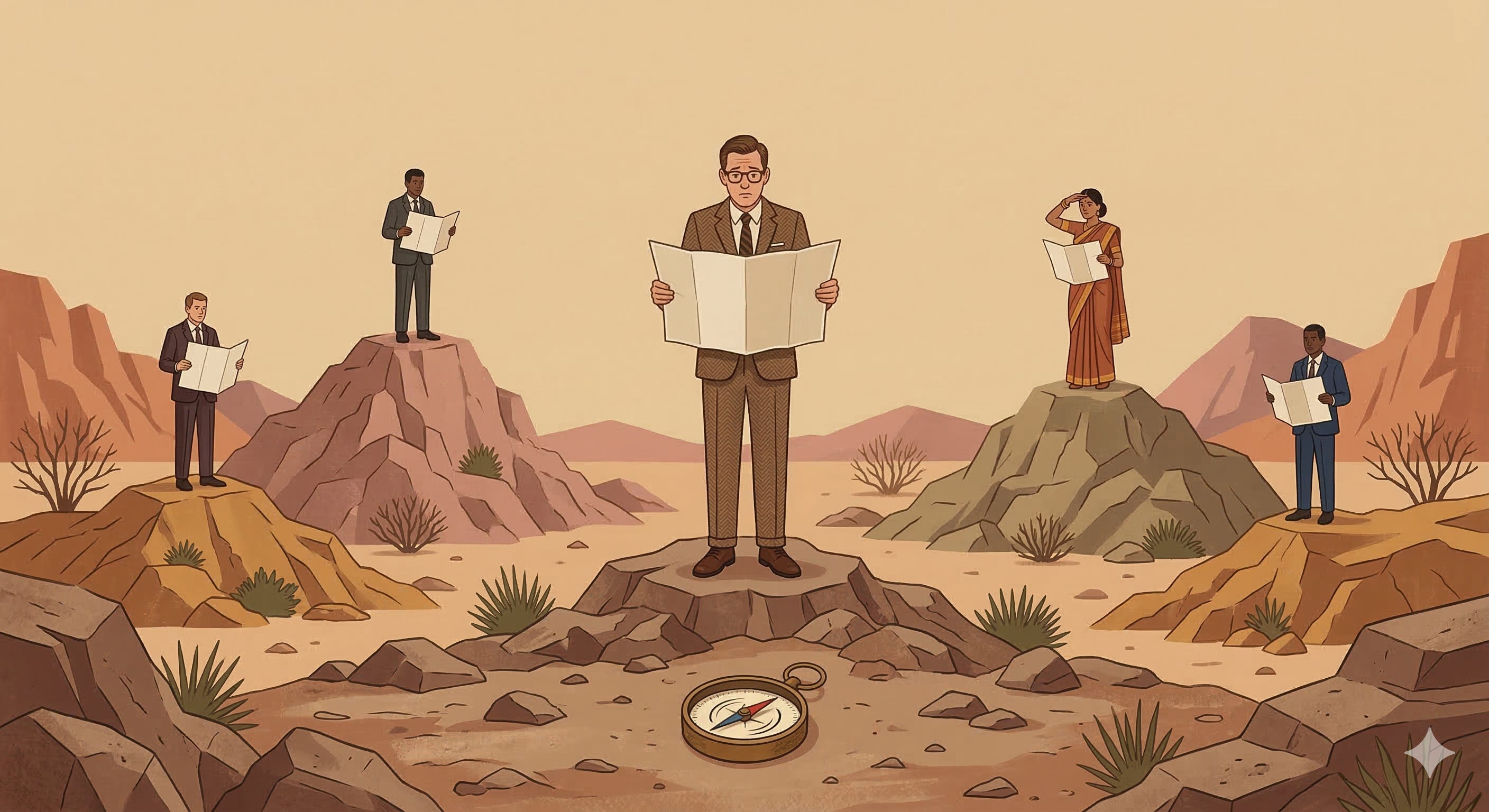
Last week, my aunt in rural Rajasthan asked me a question I wasn’t prepared for.
She was worried about her son’s future. AI, she said, might take away all the jobs. Over tea and cookies in our courtyard, I could see the fear behind her smile. Her son wanted to pursue computer science but he felt overwhelmed with the narrative that very soon, the software engineering taught in universities might become obsolete. He feared graduating with stale knowledge, student loans and no jobs.
I was taken aback. I had assumed that fears of AI displacement would take years to diffuse beyond tech circles. But here we are, 200 miles from the nearest city in small-town India, having the same conversation happening in Silicon Valley.
When a sci-fi essay erased billions in shareholder wealth
Last month, Citrini Research’s “2028 Global Intelligence Crisis” report went viral. The report imagined a scenario where rapid AI adoption triggers mass layoffs and a 38% crash in the S&P500 by 2028. The report painted a bleak picture of a world where AI agents handle most commercial activity, rendering marketplaces like Doordash and payment networks like Visa obsolete. The small prospect of this doomsday scenario triggered a ‘fear-trade’, wiping out 5-8% of the value of companies like DoorDash, American Express and Infosys that were mentioned in the report1.

The report was a thought experiment which completely ignored the upsides of AI, only focusing on ‘ghost-GDP’ arising from labour displacement caused by AI. And yet, institutional investors, managing billions, sold the stocks mentioned in the report. This goes beyond a speculative report. This is a story about how deep the uncertainty runs.
At the rate at which viral essays are moving markets, the SEC may soon have to regulate them.
When nobody understands a new technology or a platform shift, they fly to safety. They liquidate their assets and hold cash before they can ascertain where the world is going.
Maybe AI will take all white-collar jobs or maybe it will create entirely new ones. The uncomfortable truth is that no one really knows. Not the hedge fund managers, not the CEOs nor even the researchers.
And, uncertainty, it turns out, is also a product.
Is AI-efficiency being made the scapegoat for over-hiring
A few days after the report released and every tech analyst criticized it for overlooking facts and spreading panic, the narrative shifted again when Block CEO Jack Dorsey, announced that he is laying off 40% of the company’s 10,000 employees.
He cited advances in AI and increased productivity as reasons to let a large chunk of the company go. However, the irony is hard to miss. Dorsey also founded twitter (now, X) - a company Elon Musk proved could run on fifth of its workforce after taking over.
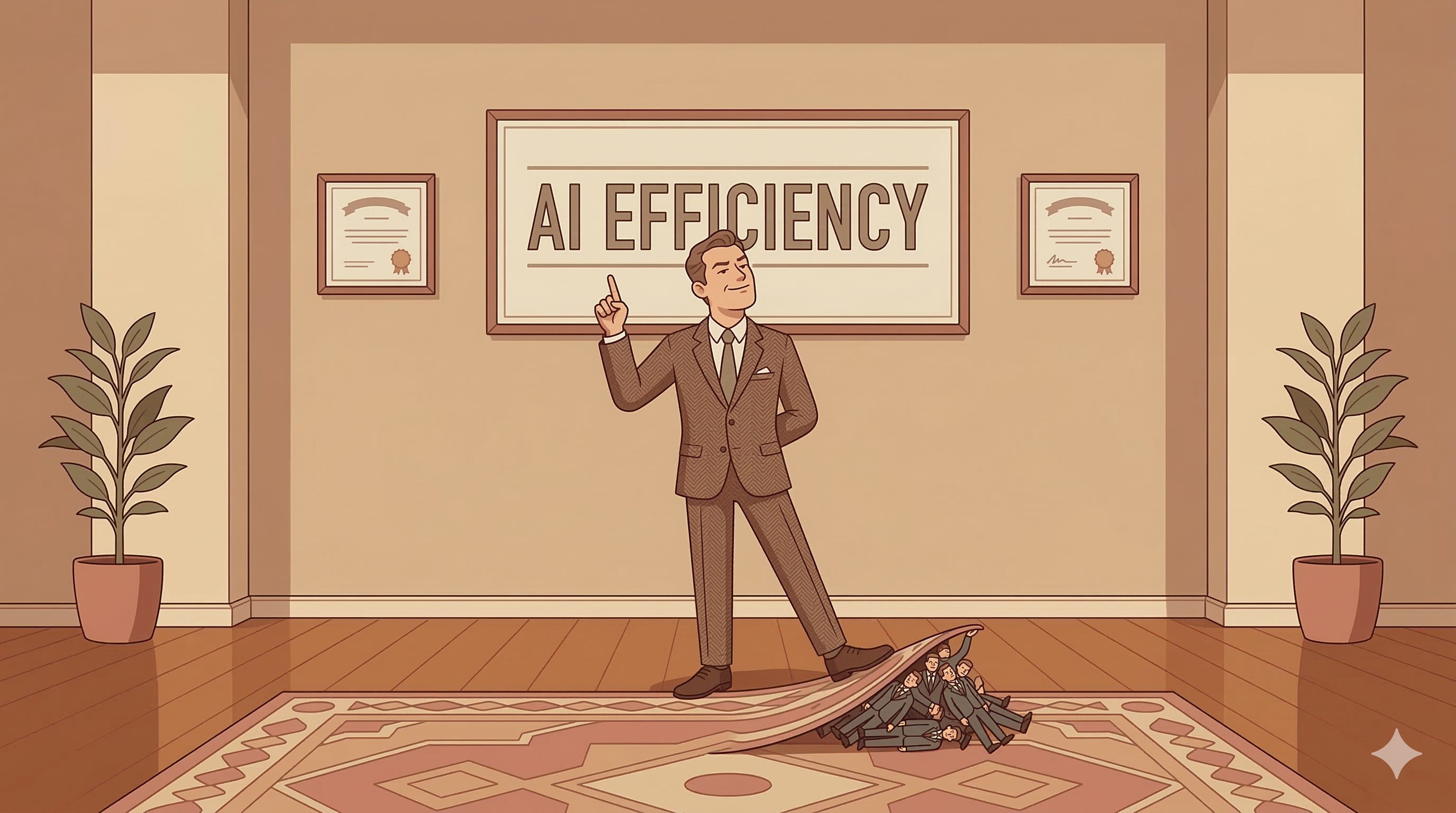
Many CEOs can now blame a technology shift to clean decks and reduce over-staffed departments. Some companies may genuinely be automating work. But for many others, AI efficiency can become the perfect alibi to chop off thousands of jobs. Culturally acceptable and conveniently timed.
The map is running out
When Dario Amodei, Anthropic’s CEO, said that AI could eliminate most white-collar jobs, it sent panic waves into newsrooms and dinner tables alike.
AI is moving faster than any other platform shift in history, but at the same time we also need to consider the incentives. Big tech giants are deeply invested in each other’s AI futures (Amazon invested $50 billion in OpenAI’s $110 billion fundraise, alongside NVIDIA).
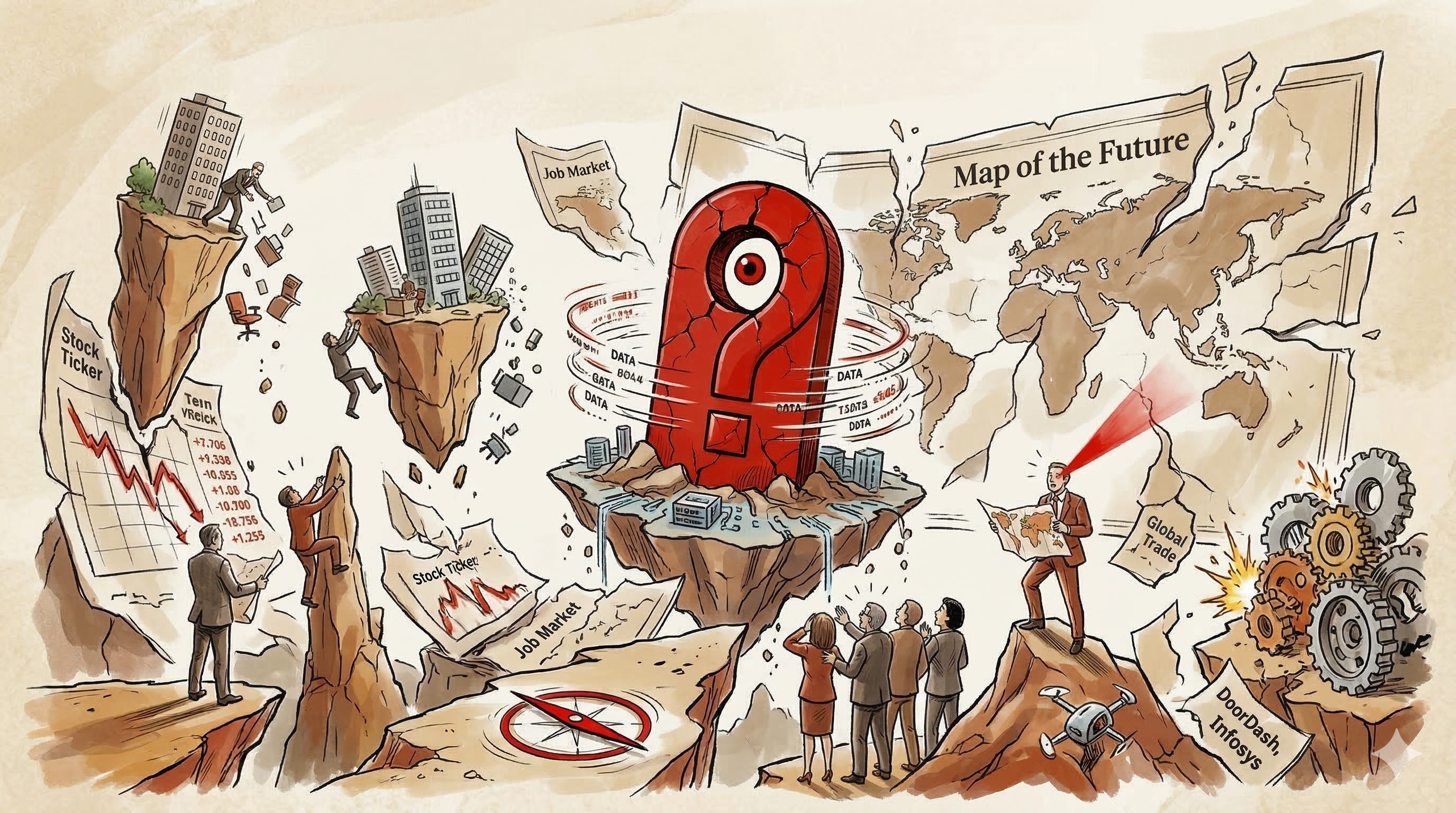
We have no idea how close we are to a ‘country of geniuses in a data center’.2 Even the poster-boys of the AI era are also living on a knife edge. Dario recently explained that despite Anthropic’s revenue growing 10x annually, it might only take a few bad quarters to derail their plans to meet the massive Capex requirements.
With the speed of progress in AI, the map has run out. We are all now navigating without one, even the people who are supposed to be ‘in the know’.
Altitude gives more confidence, not more accuracy
Everyone is facing the same questions, but at different altitudes.
I told my aunt what I truly believed. I sent her a Paul Graham quote: “Just study what you like. Don’t think about long-term consequences.”
She probably expected something like a roadmap, and I gave her a philosophy.

But that’s the point: the hedge fund manager, the frontier lab CEO, the Block engineer who just got laid off, we’re all working with the same incomplete map.
The cruel joke is that a higher altitude doesn’t give you more accuracy, just a bit more confidence. But knowing the map ran out doesn't mean we stop moving.
What my grandfather and my uncle got right
I am no AI doomer. Every platform shift, be it internet, computers or mobile rewarded the people who embraced it early.
So instead of asking what AI will destroy, let’s ask a different question: what skills looked valuable in your parents' generation that still look valuable in yours? The answer is surprisingly stable.
The two buckets. I call them ‘craft’ and ‘iron’.
Craft is the set of human skills that have never been automated because they were never mechanical in the first place. Writing, taste, and sales form the core of this bucket.
My grandfather wrote a letter to the Prime Minister requesting better electricity for our village. Handwritten, precisely argued, persuasive. Seventy years later, that skill, writing with texture and intent, is worth more than ever. When everyone’s text is AI-generated, the person who can make you feel something through words becomes rare and expensive.
Taste is judgment. It’s the ability to remove the noise and curate what matters across music, design, art, products. That kind of curation, knowing what’s good and why is genuinely hard to automate.
Sales. The gift of convincing another human being that something has value is timeless. In Silicon Valley, the hottest new role is of a ‘storyteller’3.
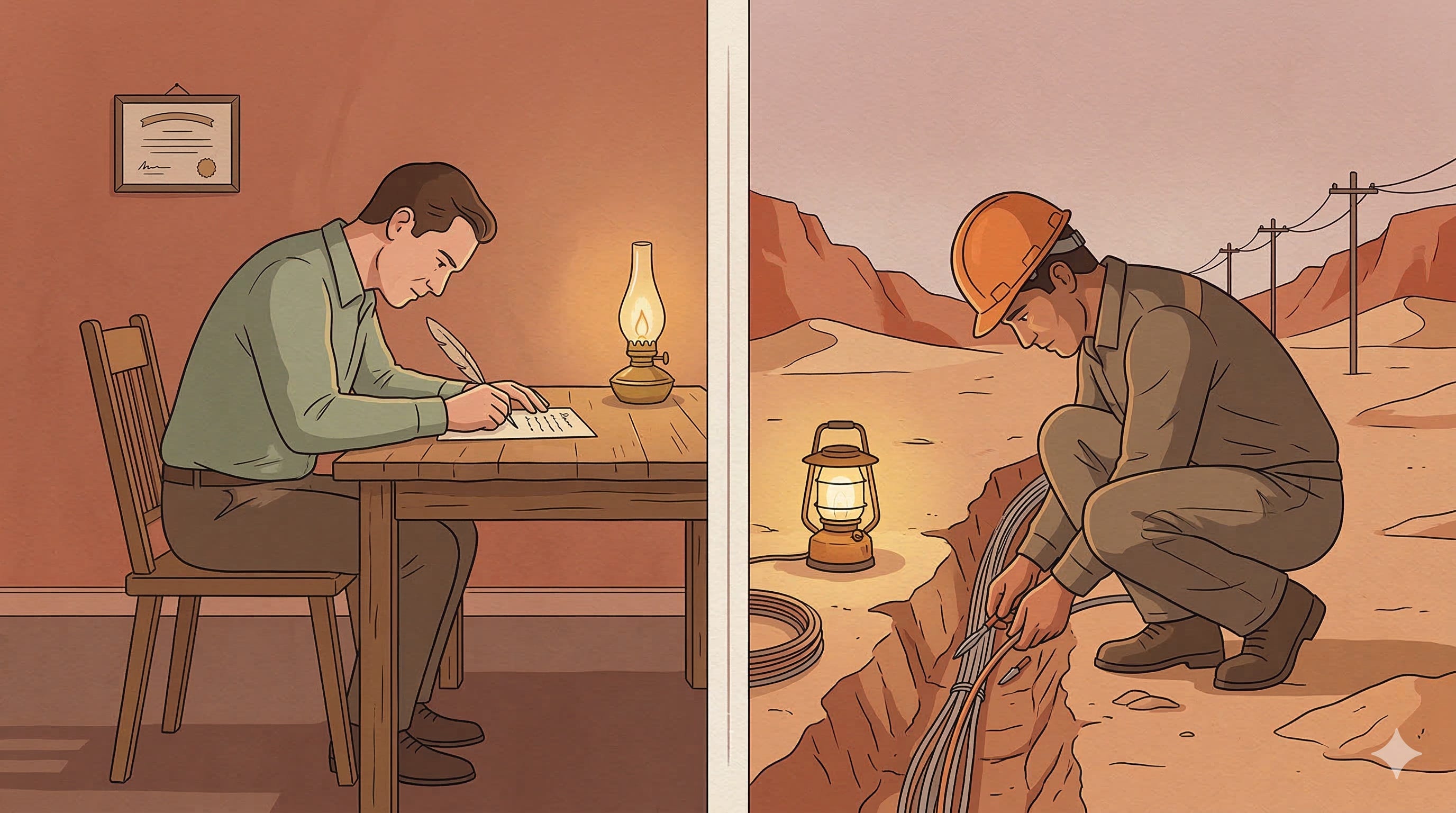
Iron is everything physical that intelligence runs on.
Iron spans the physical stack, from the electrician wiring a data center to the people quietly securing land, water, and energy for the next wave of compute.
My uncle spent forty years as a civil engineer building water infrastructure in India. He never once worried about his job becoming obsolete. His words stay with me: an engineer who can’t fix a light bulb isn’t a real engineer. As data centers multiply across the American southwest and coastal India, the electricians and builders setting them up are among the most AI-proof workers on earth.
Healthcare professionals like surgeons, physiotherapists, nurses: people whose work requires physical presence and physical judgment. A robot can assist a surgery but cannot yet replace the hands that have done ten thousand of them.
Logistics is iron too. The intelligence era runs on servers but it still needs someone to ship them.
Craft and Iron. They survived the printing press, the industrial revolution and the internet. I bet they’ll survive this too.
The map ran out. But the terrain hasn't changed as much as everyone thinks.
Critique of the Citrini Report by Citadel
Country of geniuses in a data centre: Dario Amodei
Clear take: when the future is uncertain, durable skills still beat predictions
Great piece, Keshav!