
When Reality Became Tradable
How prediction markets turned opinions into prices and attention into money

On the first Sunday of 2026, my friend came over to watch the Critics Choice awards. Every few minutes, he pulled out his phone while watching the show, I assumed he was probably doomscrolling. But when Timothée Chalamet secured best actor, he jumped with joy. He had just won $500.
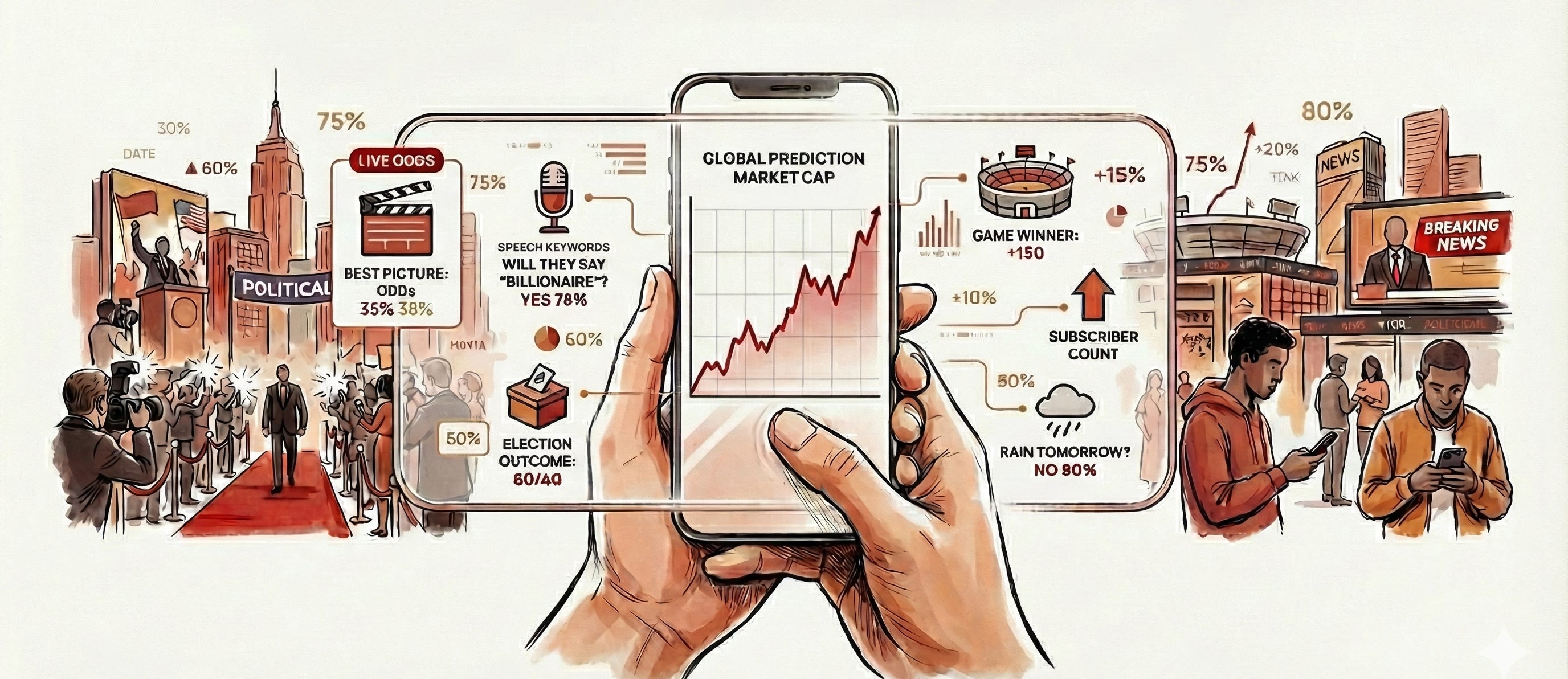
A few months earlier, when Zohran Mamdani was elected as the new mayor of New York City, the same friend was glued to the screen to watch his victory speech. He had bet $150 on whether he will use the word “billionaire” in his address.
Someone else I know regularly trades contracts on how many subscribers will MrBeast gain this month. These are engineers, consultants, normal people with jobs and mortgages. None of them would call themselves gamblers but they check the odds like our parents’ generation checked stock tickers, compulsively, multiple times each day.
Something has changed in how we engage with reality. Prediction markets went from niche to mainstream in less than 12 months, with over $2 billion worth of contracts being traded weekly1. The 2024 elections were the inflection point for Kalshi and Polymarket, but it did not stop there. They have figured out that everyone is an ‘expert on something’ and they are providing the tools to bet on it.
I think we might be watching the birth of a new asset class.
How Events Became Tradable
Tarek Monsour and Luana Lopoes Lara founded Kalshi in 2018 on the notion that people wanted to trade on a “yes” or a “no” outcome on the event itself, not through a complicated proxy of financial instruments. Kalshi, in Arabic, means ‘everything’, closely tied with Tarek’s vision of “financialize everything”, implying that anything can be traded on.
The initial years of Kalshi were defined by regulatory challenges. The first breakthrough came in 2020, when the Commodity Futures Trading Commission granted Kalshi approval to become a real exchange. But prediction markets were far from mainstream.
In 2024, a federal court sided with Kalshi and let it run prediction markets on the U.S. elections. That decision mattered deeply because elections are something everyone across demographics immediately understands and cares about. Overnight, Kalshi transformed from a cute financial product into a place people went to see reality and odds priced in real time.
Polymarket, the other major exchange in prediction markets, has taken a different path here by building on blockchain infrastructure and accepting crypto deposits to stay offshore.
Culture Never Closes
While elections opened the floodgates for prediction markets, the fastest-growing category on prediction markets is culture. Sports are still the largest category for Kalshi & Polymarket2, however, the real driver behind making these markets mainstream is, their focus on cultural events.
Sports have natural breaks in between matches and tournaments and elections happen only once in a while. But culture is an evergreen market: press conferences are held daily, Spotify charts move everyday and movies are released every weekend. Cultural markets give you reasons to check in all the time.
People are betting on Billboard chart positions, YouTube subscriber counts, movie box office performance, whether celebrities will make certain announcements. The volume is still much smaller than sports, but the growth rate and stickiness is far superior.
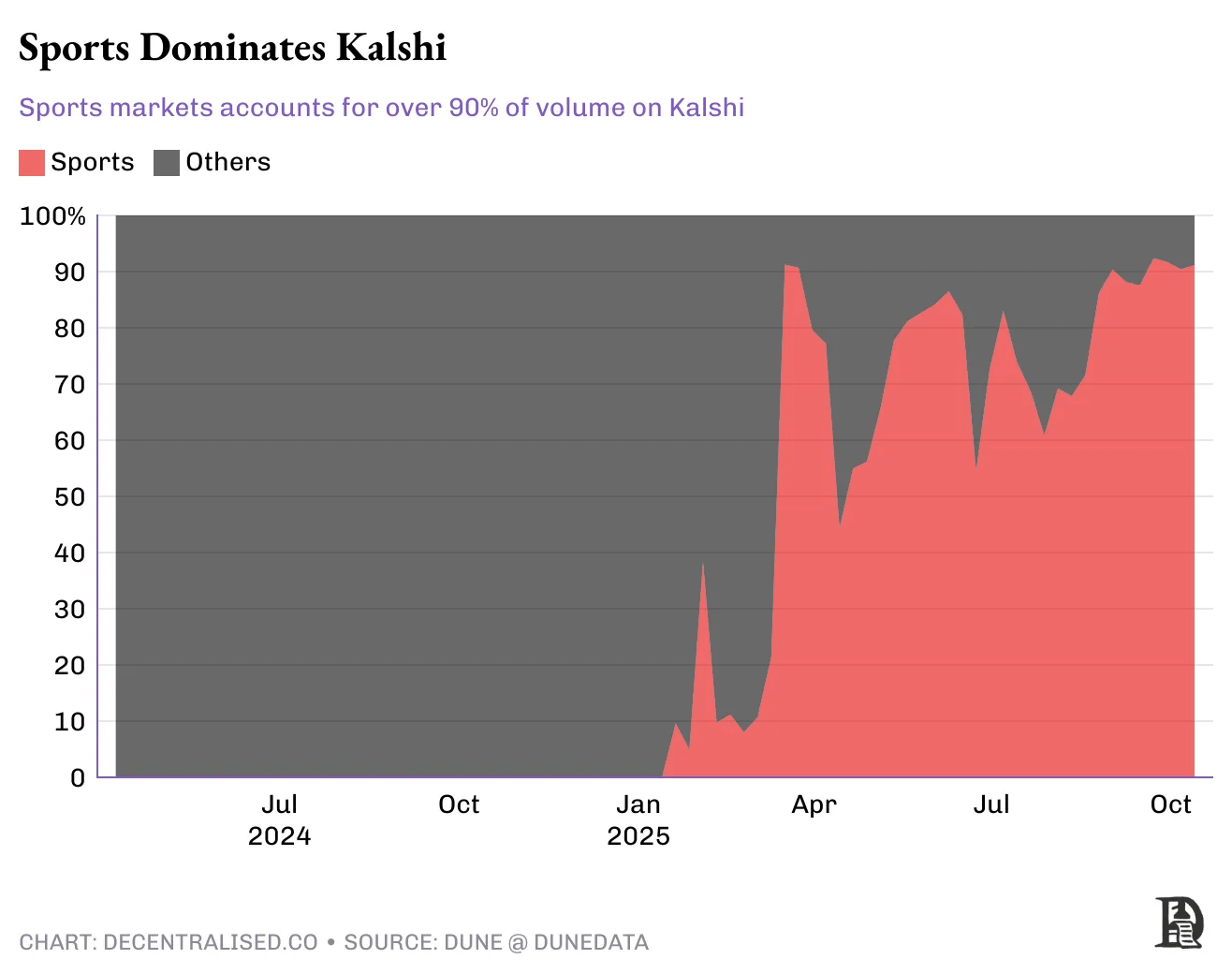
The platforms get this: Tarek, Kalshi’s CEO recently remarked on the 20VC podcast spoke on how culture is their fastest-growing segment and produces the highest weekly active user rates.
In December, Kalshi joined forces with CNN to integrate prediction markets directly into news studios. Major news outlets already reference Polymarket odds in their coverage and financial writers often cite prediction market probabilities alongside their traditional analysis. Soon, some browsers might display odds in certain search results.
The wisdom of crowds is now expressed through financial stakes and numbers that everyone understands. If thousands of people have money riding on an outcome, the aggregated probability and should be more accurate than any single expert’s opinion.
When Attention Gets a Price
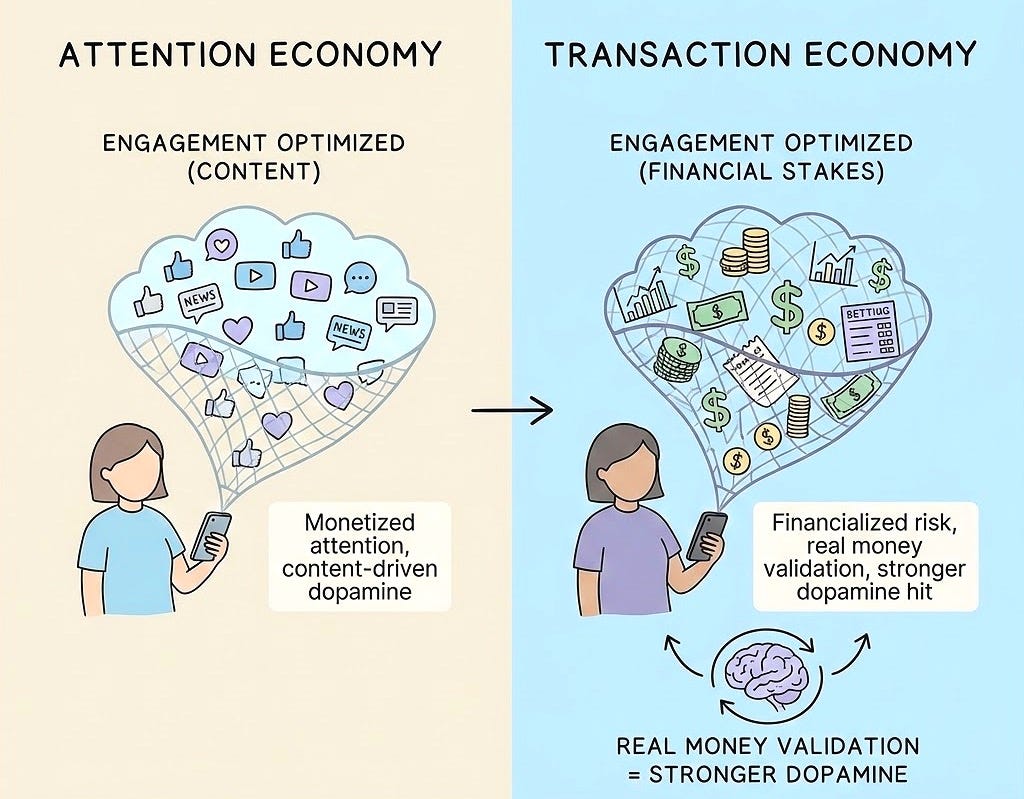
Gradually, the transaction economy replacing the attention economy. As Kyle Harrison explains in her remarkable essay, social media optimized for engagement through content whereas prediction markets optimize for engagement through financial stakes. The dopamine hit is stronger here because real money validates whether you were right.
The Money is Flooding In
In a year when AI startups have cornered a majority of venture capital raised, mega rounds of non-AI startups are rare.
Kalshi raised $1 billion at $11 billion valuation from Paradigm and a16z. This came months after Sequoia led its Series D fundraise at a valuation of $5 billion.
Intercontinental Exchange (owner of NYSE) made a strategic investment of $2 billion at a $9 billion valuation in Polymarket.
Sports still drive a large share of volume today, however, their vision is not building the next DraftKings or FanDuel (valuation: $31 billion).
Their ambition is closer to creating market infrastructure than betting. Exchanges that sit at the center of financial activity, matching buyers and sellers and clearing trades, have become some of the most valuable businesses in the world. That is what the investors behind prediction markets are betting their big money on.
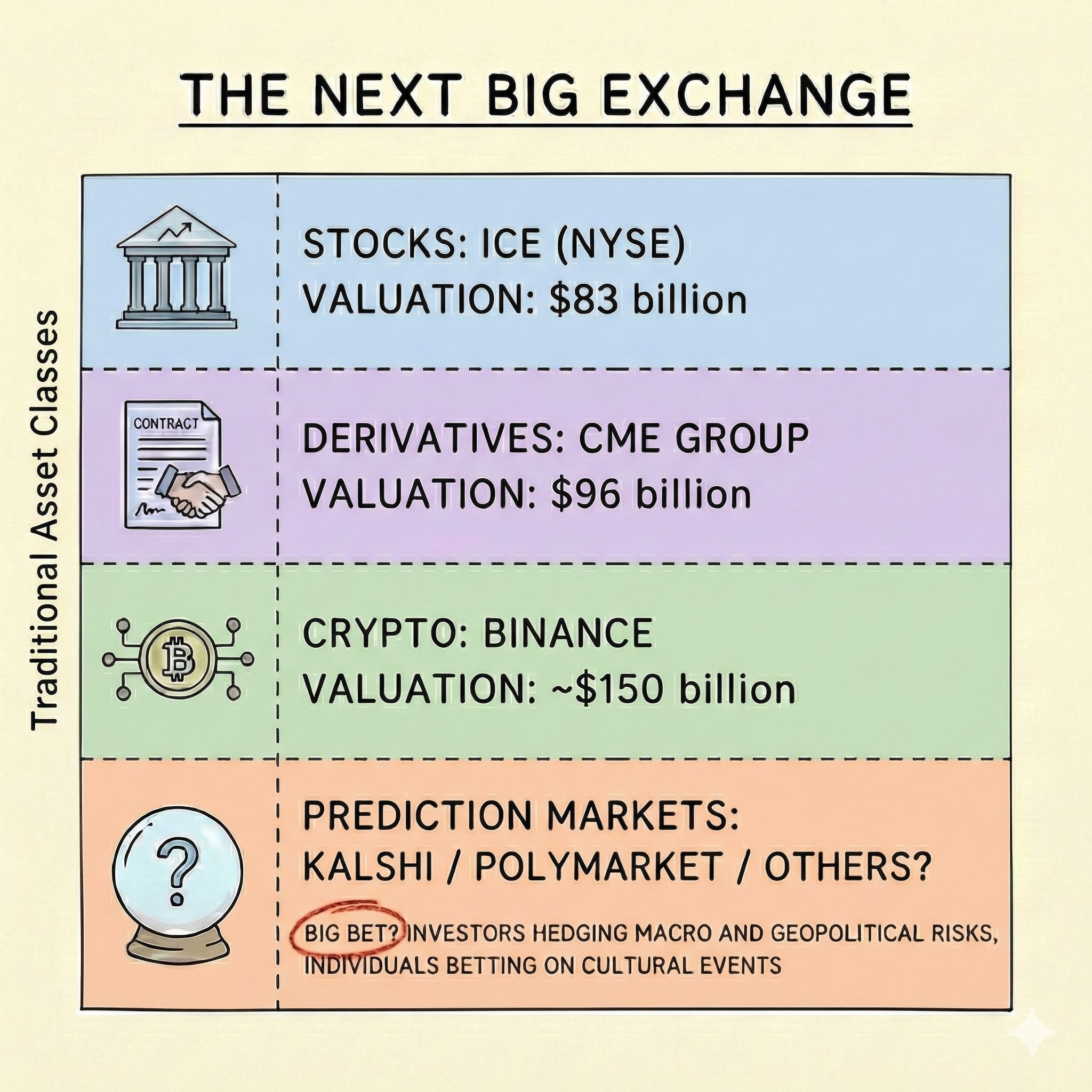
The bet is that in five years, checking Polymarket odds will feel as normal as checking stock prices. News articles will embed prediction market probabilities the same way they embed stock tickers today. Hedge funds across the world will have entire desks dedicated to trading event contracts. The infrastructure being built now and the massive fundraises are a bet on that future.
The Engagement Flywheel
There is a second-order effect that I find more interesting. These markets make the underlying event itself, more engaging!
When there’s $500,000 in bets riding on what words will be mentioned in a speech, does that change how people watch the speech? We’re only beginning to see how this plays out.
I witnessed a similar phenomenon with fantasy cricket in India.
Fantasy cricket platforms like Dream11 added a layer where a fan could build fantasy teams and earn money based on player performances. Suddenly, every ball mattered because fans started to care about every detail. They were tracking individual player stats because their lineups depended on it. So many of my friends who had lost interest in the sport as they grew up, returned in huge numbers, boosting the viewership and engagement, pushing the Indian Premier League to record valuations.
Last year, the Indian government banned fantasy sports platforms and the business model of these startups (called real money gaming) collapsed overnight. Companies that had raised hundreds of millions and reached tens of millions of users had to completely reinvent themselves.
The question that now lingers in my head is that, what will happen to IPL viewership, now that there are no fantasy platforms to play along? Will IPL 2026 see fewer viewers because that financial stake layer got stripped away? I don’t know yet, but it’s worth thinking about.
The Regulatory Knife Edge
Everything I’ve described depends on a regulatory environment that could shift at any moment.
The question is simple: Are prediction markets financial instruments or gambling?
Financial instruments fall under federal CFTC regulation with relatively permissive rules meanwhile betting falls under state regulation in the US with strict constraints. The entire industry exists in the gap between these interpretations.
Sports are the obvious pressure point. It is virtually impossible to argue that betting on game outcomes isn’t gambling. If regulators carve out sports and place it under state jurisdiction, the entire economics of the industry will change dramatically.
There are other vulnerabilities. Insider trading on cultural events is nearly impossible to police. If you’re betting on what someone will say and you know that person, you have an unfair edge and influencing these events is fairly easy. The enforcement infrastructure simply doesn’t exist yet.
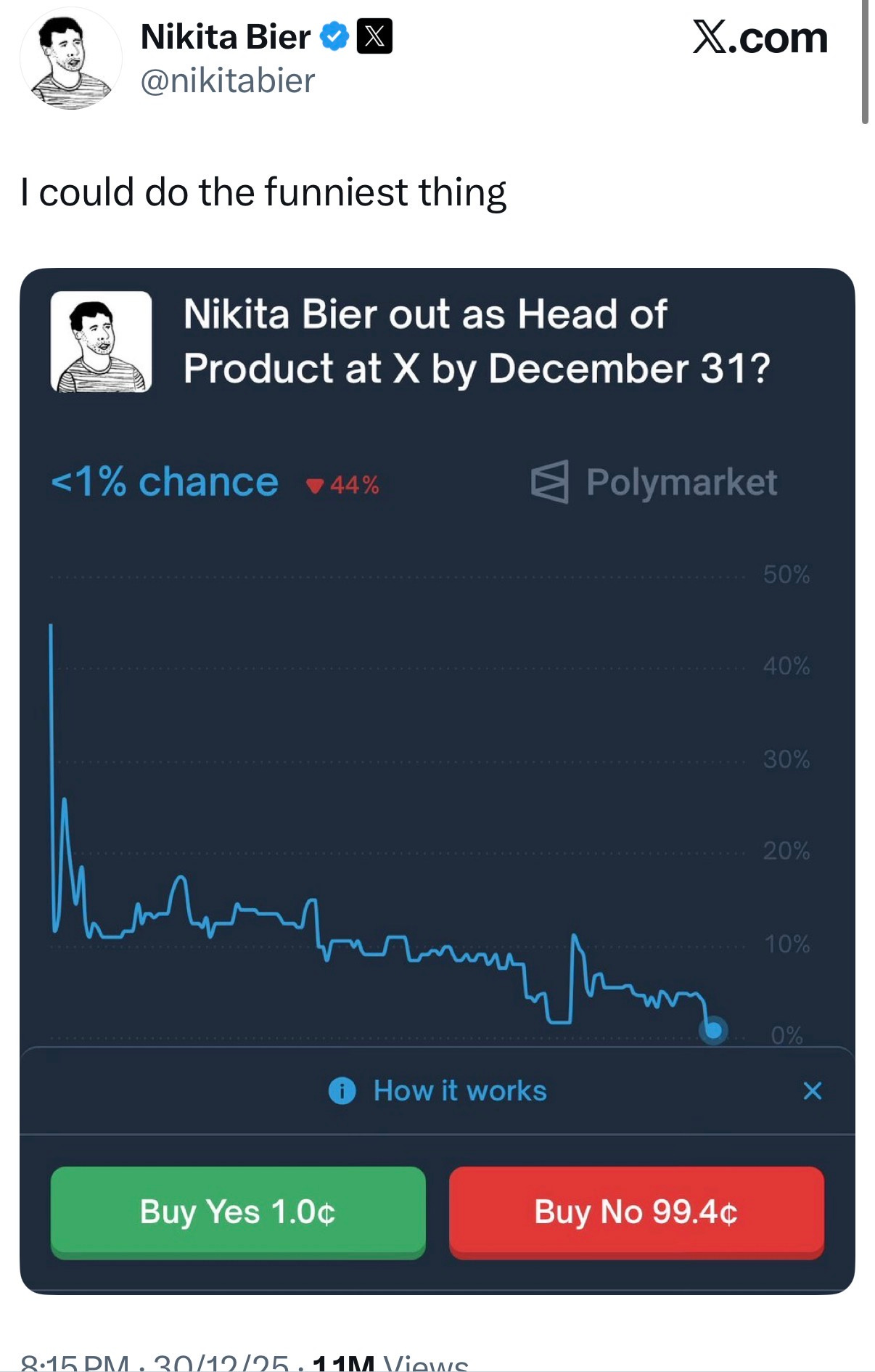
The industry knows this window might close and they are moving at breakneck speed. Raising billions, signing distribution deals with major media companies, expanding into new categories. They are trying to become too embedded to regulate away before regulators catch up.
The Information Paradox
Prediction markets are positioned as information discovery mechanisms. The theory is elegant: when people have money at stake, they price events more accurately than any expert could.
But the more we treat these markets as sources of truth, the more they shape the events they’re measuring.
A movie that prediction markets say will bomb might get fewer screens from theaters, which affects box office performance, which validates the prediction. A candidate that prediction markets favor might attract more donations, which improves their actual chances of winning.
We’re creating feedback loops where the act of measuring probability influences the outcome. Stock markets have worked this way forever and it is not necessarily bad. The price of Chipotle’s stock affects the company’s ability to raise capital, which affects its actual performance, which in turn affects the stock price. We’ve learned to live with that circularity.
But prediction markets apply that same circularity to culture and events. And I’m not sure we’ve thought through their implications. When there’s serious money riding on what someone will say in a speech, does that person feel pressure to say or not say certain things?
The deeper these markets are embedded, the more acute this risk will get.
The Long View
When everything becomes a market, what do we lose?
When every event is an opportunity to prove you were right and make money, what happens to just being present?
The platforms and investors will tell you this is about democratizing information and making markets more efficient. That’s partially true. But it is also about finding new ways to monetize attention in an era where traditional advertising is getting less effective.
Prediction markets have figured out that the way to compete with social media is to add a transaction layer that makes every scroll potentially profitable. The dopamine hit of being right and making money is stronger than the dopamine hit of getting likes or going viral. Whether this creates durable value or just accelerates our collective addiction to validation is the bet we’re all making, whether we know it or not.
For now, the momentum is undeniable. Billions of dollars in capital, mainstream distribution deals, explosive user growth.
Or we might be watching a regulatory window close in slow motion, with fortunes made and lost before anyone fully understood what was being built.
The odds are probably on Polymarket. Someone’s betting on it.
Weekly Volumes of Kalshi: reported by Kalshi
Kalshi revenues for 2024-25: Yahoo Finance
Great article!