
Why People Are Injecting Themselves With Internet Drugs
How Ozempic, influencers, and underground peptides have turned body optimization into mass behavior

A couple of months ago, I wrote an essay about going analog. I had ditched my smart watch and stopped tracking sleep and recovery. My argument was simple: we have over-instrumented our lives and adding new metrics becomes a new form of anxiety.
It felt like a small act of resistance in a world wired to optimize every single thing.
But then last week, Instagram showed me a reel that made that entire idea feel almost naive.
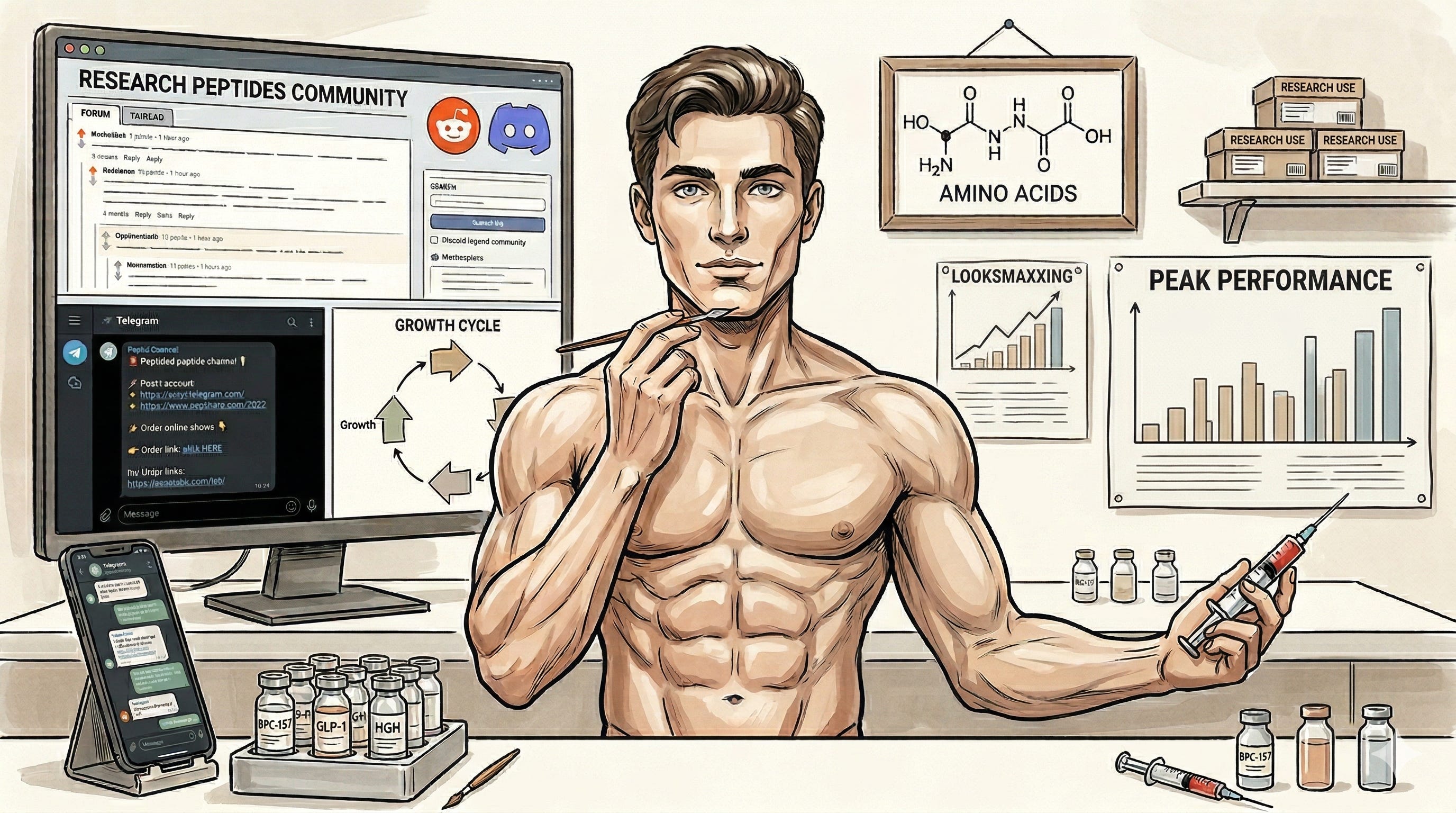
A guy named Clavicular sat in front of the camera explaining how he was “bone smashing” his face to improve his jawline. He spoke in a flat, robotic tone as he punched his own cheekbones. Between these clips, he casually mentioned his night-time stack: testosterone, growth hormone, and something called BPC-157.
A peptide that, he said, helps your body heal faster and to my surprise, the comments section was full of teenagers asking for dosages.
A few days later, I was talking to a friend in Bangalore, who goes to a fancy gym in HSR. He’s not a biohacker or one of those Silicon Valley dudes who wants to ‘engineer his health’. Just a regular guy who lifts, eats clean, has a job.
Mid-conversation, he said, almost offhand, “My gym trainer is asking me to try retatrutide.” I was curious what it was and asked him.
“New drug, like Ozempic but better. You can get it for less than $60. I’ll send you the link.” He sent me the link, it was a website called biopeptide.in, selling retatrutide for ‘research purposes’.
Two months ago, I was writing about deleting wearables and metrics and today, people around me are injecting research chemicals sourced from the shady parts of the internet.
What the hell is happening?
What are peptides, and why are they everywhere?
At the simplest level, a peptide is just a short chain of amino acids. A smaller version of a protein and our body already uses a ton of them, for example, insulin and oxytocin are peptides.
The cultural version is more nuanced than the wikipedia definition:
When people say 'peptides' today, they mean something specific: drugs that promise targeted changes to your body. They promise control: over your weight, your recovery, your sleep and even your appearance.
And unlike most supplements, they tend to work fast and visibly (at least according to the internet).
The inflection point in the peptide story was GLP-1s. By now, everyone knows about Ozempic, Semaglutide, Monjauro. These are weight loss drugs that suppress your appetite so effectively that you can lose 15% of your weight within 2-3 months.
But they are more common than you think: nearly one in seven Americans is now taking a peptide. Closer to home, I’ve met eight people who are/were on Monjauro in my hometown, Jodhpur. Mind you, this is a tier-2 city, far from the usual metros like Mumbai or Delhi.
GLP-1s made peptides a cultural phenomenon.
Before that, peptides were popular in niche communities of bodybuilders, anti-aging forums, or a few doctors. After Ozempic, the idea that you could inject something once a week and fundamentally change your body stopped feeling so extreme.
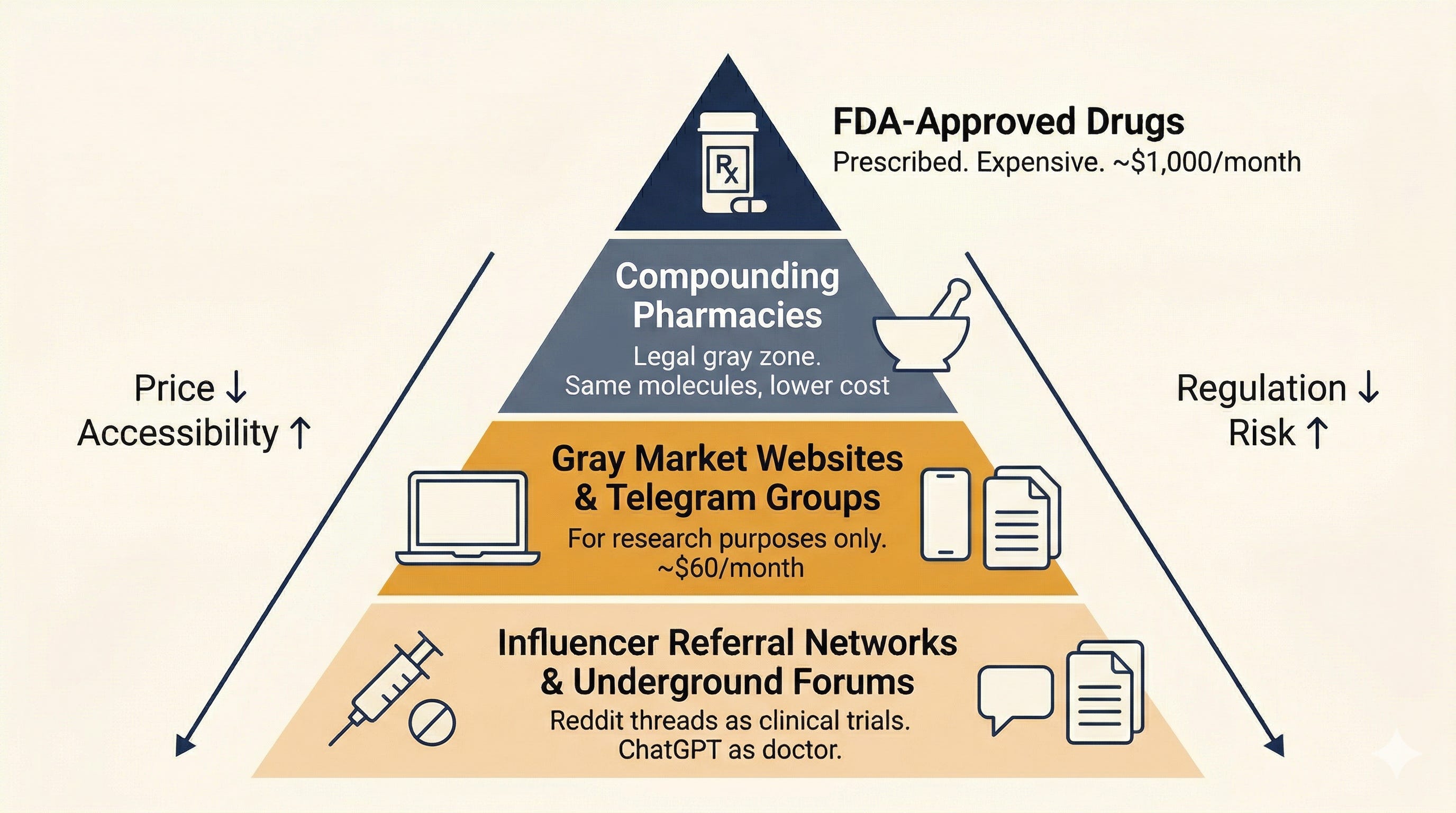
From there, the market for peptides has fractured:
At the top, you have FDA-approved drugs. Expensive, regulated, prescribed and available through the regular channels.
Then some compounding pharmacies which operate in legal gray areas where the same molecules are produced more cheaply.
And below that sits the actual gray market. Websites, Telegram groups, Reddit forums, all selling products labeled “for research purposes,” but clearly intended for human use.
Influencers source their peptides cheaply through these grey markets and many of them offered referral codes and community sign-up links in their discord to new users who may discover these products through their content.
And once you step into that world, peptides stop looking like fringe science and start looking like tools.
The ‘looksmaxxing’ economy
If peptides were just a medical story, they would have stayed niche but they have emerged at a point where people are investing a huge amount of time, effort and money to become the ‘best-looking’ version of themselves.
“Looksmaxxing” is an online subculture focused on maximizing physical attractiveness through, at times, extreme (and very weird) methods.
It is popular among young men on social media and ranges from traditional methods like dieting, strength training, skincare routines to more risky, unproven methods like surgical procedures and bone-smashing (breaking your facial bones to reshape them)
The term has caught on like wildfire in a diluted, algorithm-friendly version and it’s flag bearer is Clavicular. TikTok creators talking about jawlines, skin quality, testosterone levels and instagram reels feature “aesthetic optimization.” One simple YouTube search on the topic will reveal hundreds of podcasts about longevity and peak performance.
The audiences are different but underlying idea remains the same: your body is improvable, and you’re probably underperforming and missing out if you are not ‘optimizing’ your looks.
Peptides fit perfectly into this narrow worldview of ‘a book is as good as its cover’. Reddit threads have become research papers for these groups of young men and women who want to optimize their bodies. Telegram groups replace clinical trials in a world where ChatGPT acts as a pseudo-doctor. People run experiments on themselves, post results and routines, and others copy them.
One drug breaks opens the door (Ozempic). BPC-157 for recovery comes next and soon you are introduced to retatrutide. Influencers accelerate everything in this process.
Therapy became acceptable and celebrated through Instagram and meditation grew through podcasts. Peptides are also following the same arc, but faster.
Because unlike therapy or meditation, they do not need months of regular practice to deliver results. They deliver visible, often immediate results within the first few weeks. And that changes behavior much more quickly than any ideology.
What people are actually taking
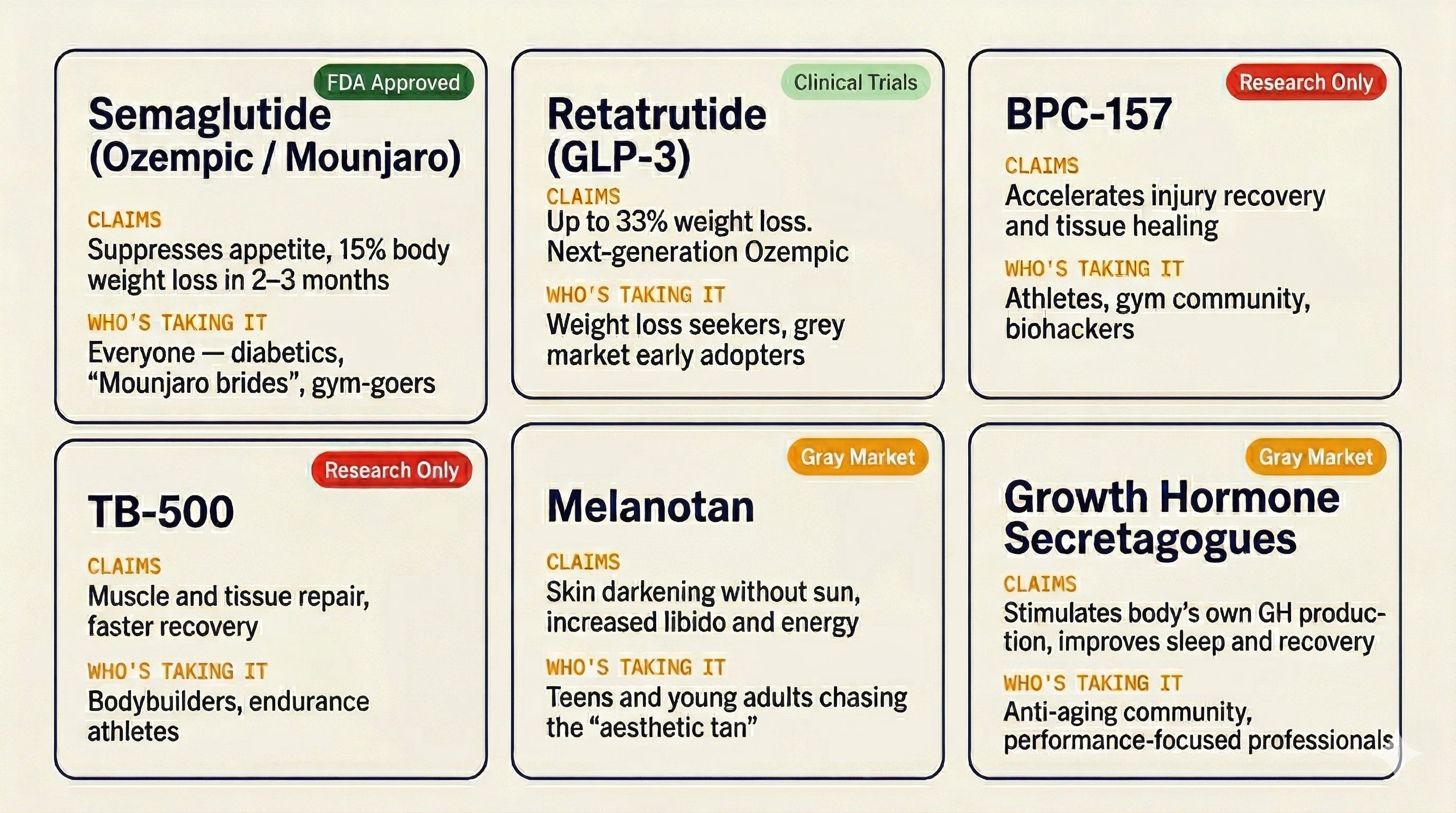
Strip away the noise, and a handful of peptides dominate the conversation:
Retatrutide or GLP-3 drugs: the next wave of weight loss drugs. Early trials suggest up to 33% weight loss within 2 months. Still experimental but widely circulating in grey markets across different countries.
BPC-157: the internet’s favorite “healing peptide” as people claim it accelerates recovery from injuries. There is almost no human data, but the anecdotes are everywhere, just open your instagram and type BP-157 in the search box.
TB-500 sits in a similar category, focused on muscle and tissue repair.
Melanotan: It is a strange drug that teens take to achieve the perfect “tan”. It darkens skin without sun exposure and apparently spikes libido and energy.
Growth hormone secretagogues: compounds that stimulate the body to produce more growth hormone, improving recovery and sleep.
None of this is clean science or proven clinically. Most of these claims are based on anecdotes, not long-term human studies and these drugs can often come with long term side-effects.
These experimental peptides have been studied in some form for decades. BPC-157, for instance, has existed in research contexts since the 1990s, but it is only through this weird amalgamation of tech, culture and health that it has become mainstream.
But the gap between “studied” and “safe for widespread use” is massive. These compounds, however cool they might sound, live in a space where long-term risks are unclear. Which leaves individuals to decide their own tolerance.
Peptides are no longer confined to tech bros
All this may paint a picture of the dystopian world limited to the inner circles of Silicon Valley which has long been the bastion of biohackers, longevity podcasts and performance-obsessed founders. But it is already showing up closer to home.
Trainers in Bangalore are recommending GLP-3s to clients who want to ‘lose weight fast’. These aren’t biohackers but regular people who lift, scroll Instagram, and pick up ideas from podcasts and reels the same way anyone else does. It is also no longer limited to the ‘elites’ in Bandra who will spend $1000 a month. A monthly dose now begins from as little as $60.
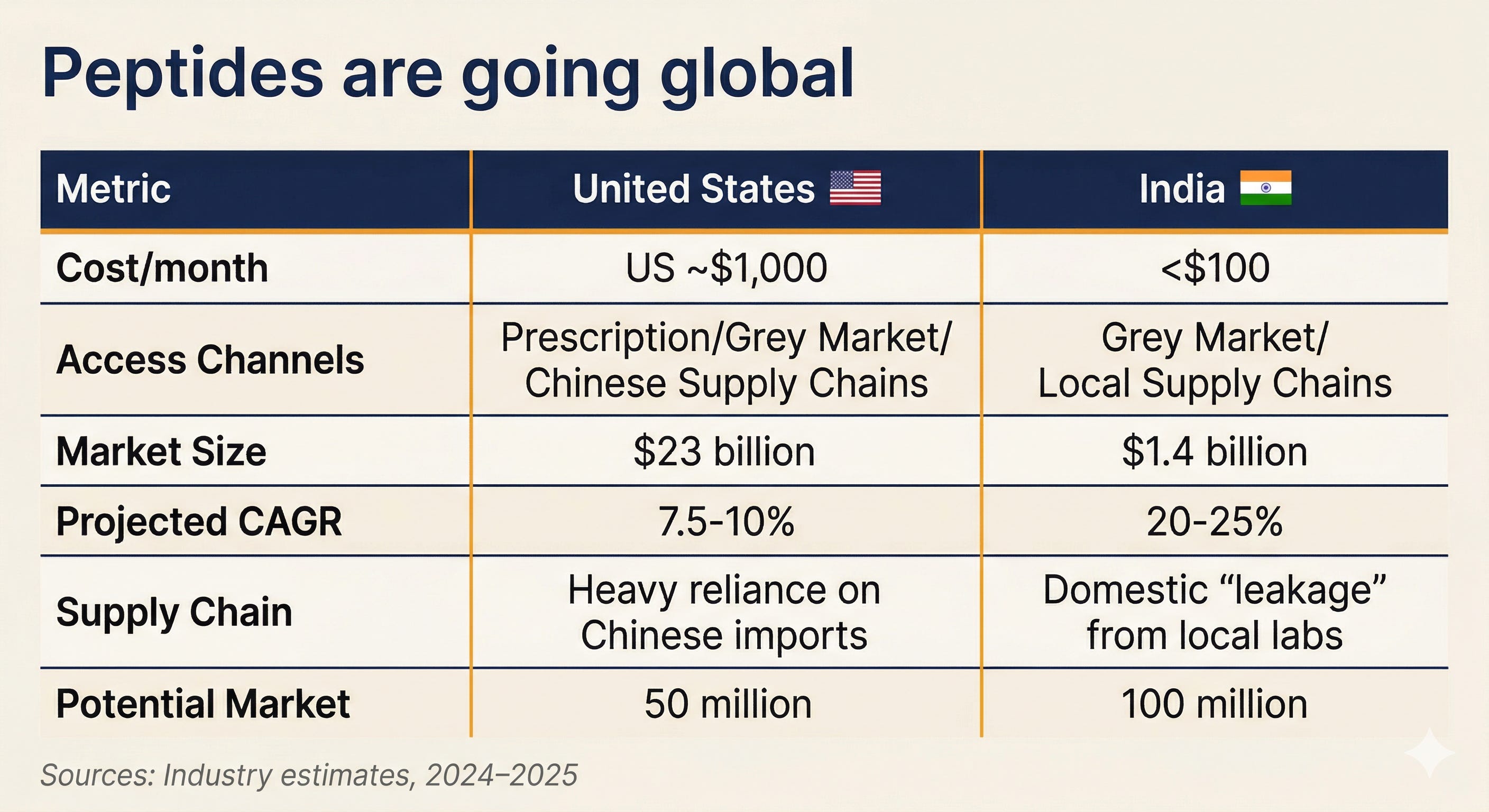
The patent for semaglutide expired in India and China in late-March, which led to a flurry of generic GLP-1s launched by all major Indian pharmaceutical companies, starting from as little as ₹2,500/month. India is already the world’s generics factory and these factories will pump out GLP-1s to meet the ever-increasing demand.
The awareness of GLP-1s in India is growing. Since the past 3 years you could see early signals in plain sight as Bollywood celebrities who historically struggled to lose weight, suddenly became lean.
Speculation is quickly turning into behavior and that effect is most clearly seen in Indian weddings.
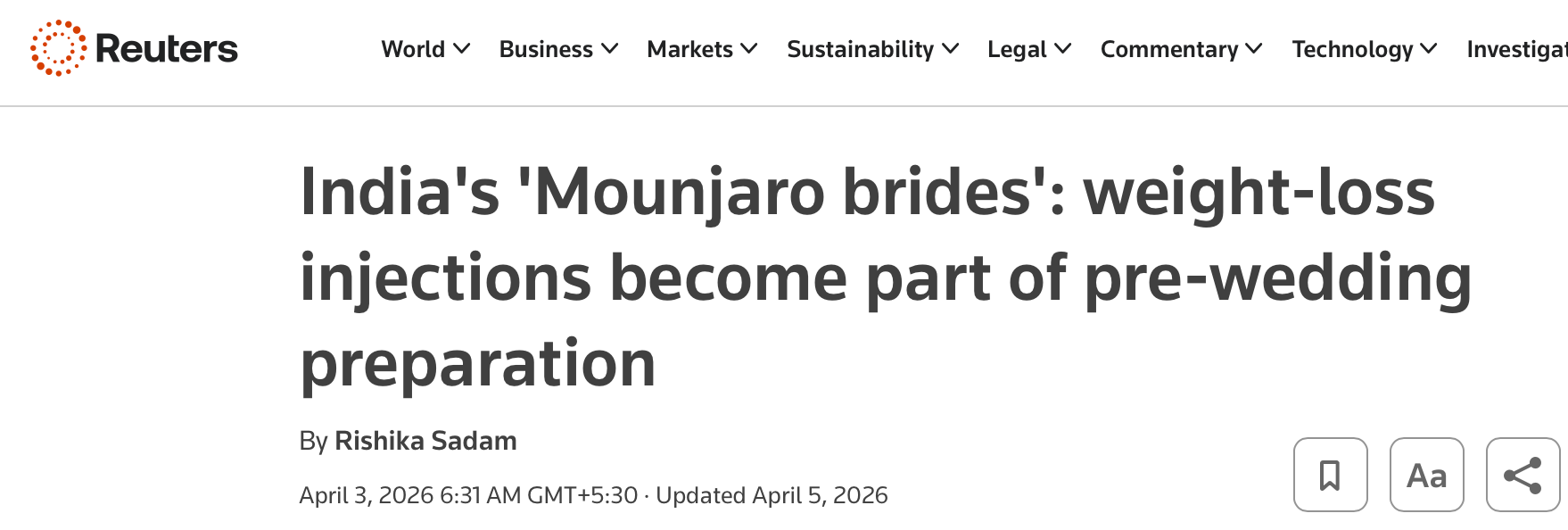
“Monjaro brides” is the newly coined term for brides-to-be who want a quick solution to lose 8-15 kilos before their D-Day. Do you think these women and men would care whether Retatrutide (GLP-3) is FDA approved? Not when it promises to drop 15 kilos in 8 weeks.
And once more people accept that a weekly GLP-1 injection can reliably change how they look, the leap to other peptides doesn’t feel that large.
India compresses adoption cycles. What took the United States 5 years to reach can be achieved in India within 3 years. Drugs that cost over a $1,000 in the US for a jab cost less than $40 in the generic Indian market. At that price point, this stops being elite biohacking and becomes a mass behavior.
This isn’t about whether peptides will come to India. The deeper question is how quickly will they move from gym conversations and become routines.
Why This Is Happening (And What It Says About Us)
While I was busy throwing away my Apple Watch, others were moving in the opposite direction. Injecting themselves with peptides.
When I read that one in seven Americans is now on a peptide, I went down a rabbit hole trying to understand why.
The answer is more cultural than medical
After Covid-19, people stopped trusting the system to tell them what was safe. Whether you were pro-vaccine or anti-vax, one thing became pretty clear: you could not outsource your health decisions anymore.
So, people started taking control of their health. Nowadays when you are ill, you do not rush to a doctor first. You ask ChatGPT, scroll Instagram, read reddit threads and form your own thesis. You follow someone on social media who looks the way you want to look and has achieved the transformation.
And if that person tells you their “stack” helped them lose weight, fix their skin or sleep better, you are hooked and start going down the rabbit hole (like I did) to discover the best routines and products to help you.
The larger story is that people no longer desire just good health, they want agency. Peptides are appealing because they are direct, fast-acting and, it gives people the feeling that they are in control. After Covid-19, people have started to believe that “we are all responsible for our own health”.
It is empowering. But is it also overwhelming?
Because once you feel you can modify every aspect of your body'; it is hard to stop.
Every flaw becomes fixable and every version of you feels unnatural.
I thought opting out was the answer, fewer metrics and lesser noise. But maybe it’s just a different way of coping. Because the people injecting peptides aren’t irrational. They are very smart, well-researched and they are reacting to the same that I am.
I don’t know if this is the future of medicine or the next wave of self-inflicted anxiety.
But I do know this: we’ve reached a point where people are no longer satisfied just tracking their bodies.
They’re trying to rewrite them.
Thank you for reading. More of my writings live here, and learn more about me.
If you found this interesting, I'd love to hear your thoughts. Share them on Twitter or LinkedIn.
"Because unlike therapy or meditation, they do not need months of regular practice to deliver results. They deliver visible, often immediate results within the first few weeks. And that changes behavior much more quickly than any ideology."
This my friend, I think is the biggest reason for the uptake of GLP-1 and predecessors. As a society we've been trained to want everything now and like you said covid has had a huge impact on people's health awareness. The combination got it's ultimate solution. Fast-acting weight loss drugs.
Great article as always! I am scared of what this kind of body optimization could do to people’s self esteem. If more and more people start using biohacks to look perfect, it might make anyone feel like there’s something wrong with them even if they are completely healthy and normal.