
Is India Missing Its Mango Moment?
India produces 40% of the world's mangoes. It exports almost none. The fix is more interesting than the problem.

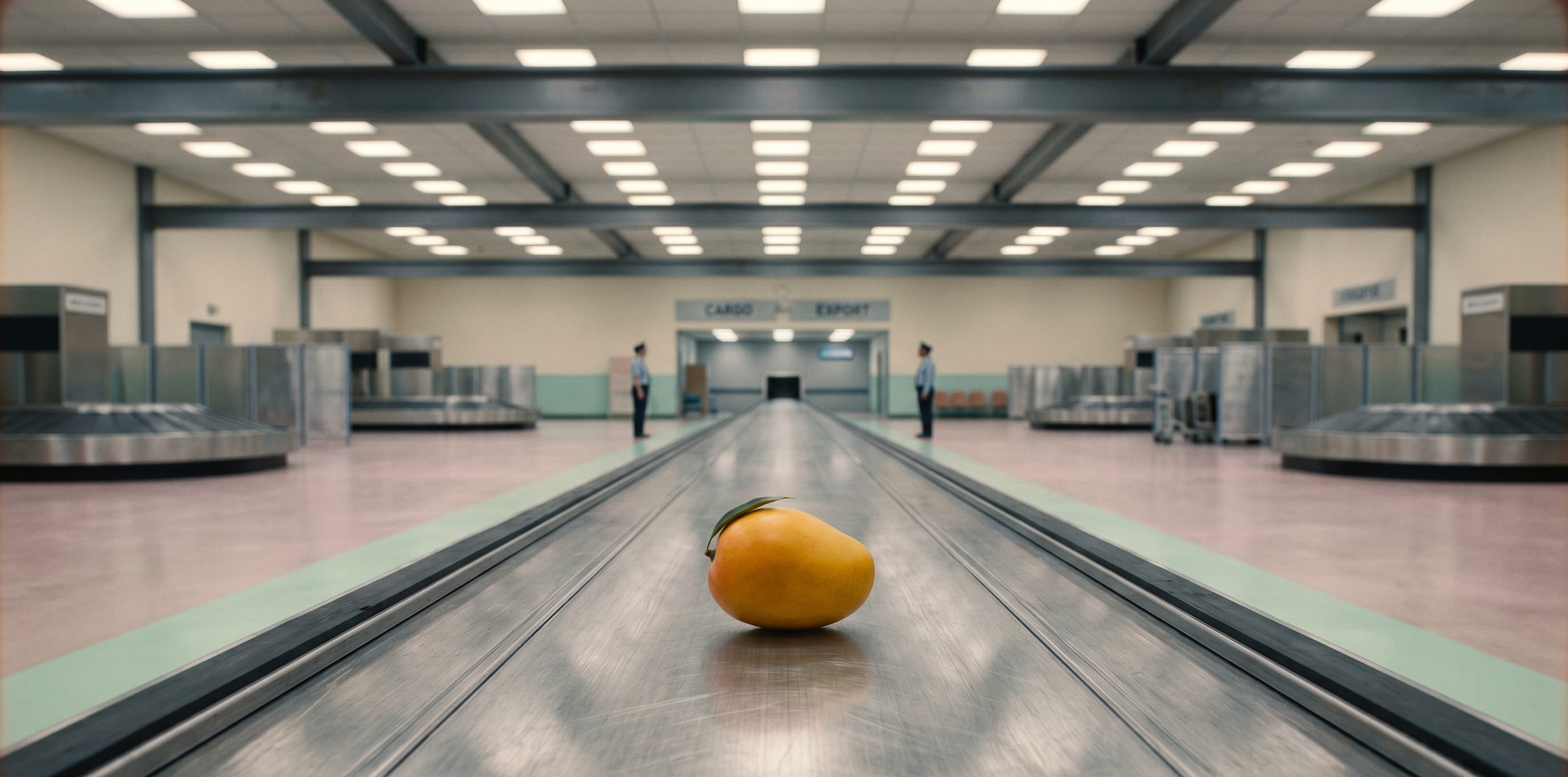
I spent the last couple of months in India, in the middle of one of the worst heatwaves in recent years. However, a couple of things make India’s summers enjoyable even when the sun soars past 115 degrees: IPL cricket and mangoes. The former is living its best life with teams hitting billion dollar valuations and Stephen Schwarzman, the world’s top private equity professional repping merch from the title-winning franchise. IPL Cricket has literally captured the American-Capitalist’s zeitgeist. The other half, Indian Mangoes are also having a cultural moment in the US, but theirs is just getting started.
Last week, my jaw dropped when I saw a dozen Indian Alphonso Mangoes retailing for $70 at Costco in New Jersey. Across the aisle sat the Ataulfo Mangoes from Mexico, retailing at $8.
This piqued my curiosity and I stumbled upon this Wall Street Journal article that detailed how Americans are shelling out as much as $1,000 for season passes from a Chicago importer to secure their season’s supply of fresh mangoes. I opened Twitter and visuals of an “Indian Mango Party” caught my attention where 200 people gathered to eat and celebrate mangoes.
I wondered: this is what India has and doesn’t know what to do with.

The opportunity hiding in plain sight
India exports too few mangoes and every summer there is a flurry of articles that echo this sentiment. However, the deeper problem is that India is exporting the wrong variety of mangoes, from the wrong places, through the wrong structure. Even if India manages to fix one of these three pieces, the needle will move meaningfully. Fix all three and India can build a corridor that carries the exports of next twenty agri-products with it.
Why am I claiming India is exporting the wrong mangoes? The answer lies in the export data:
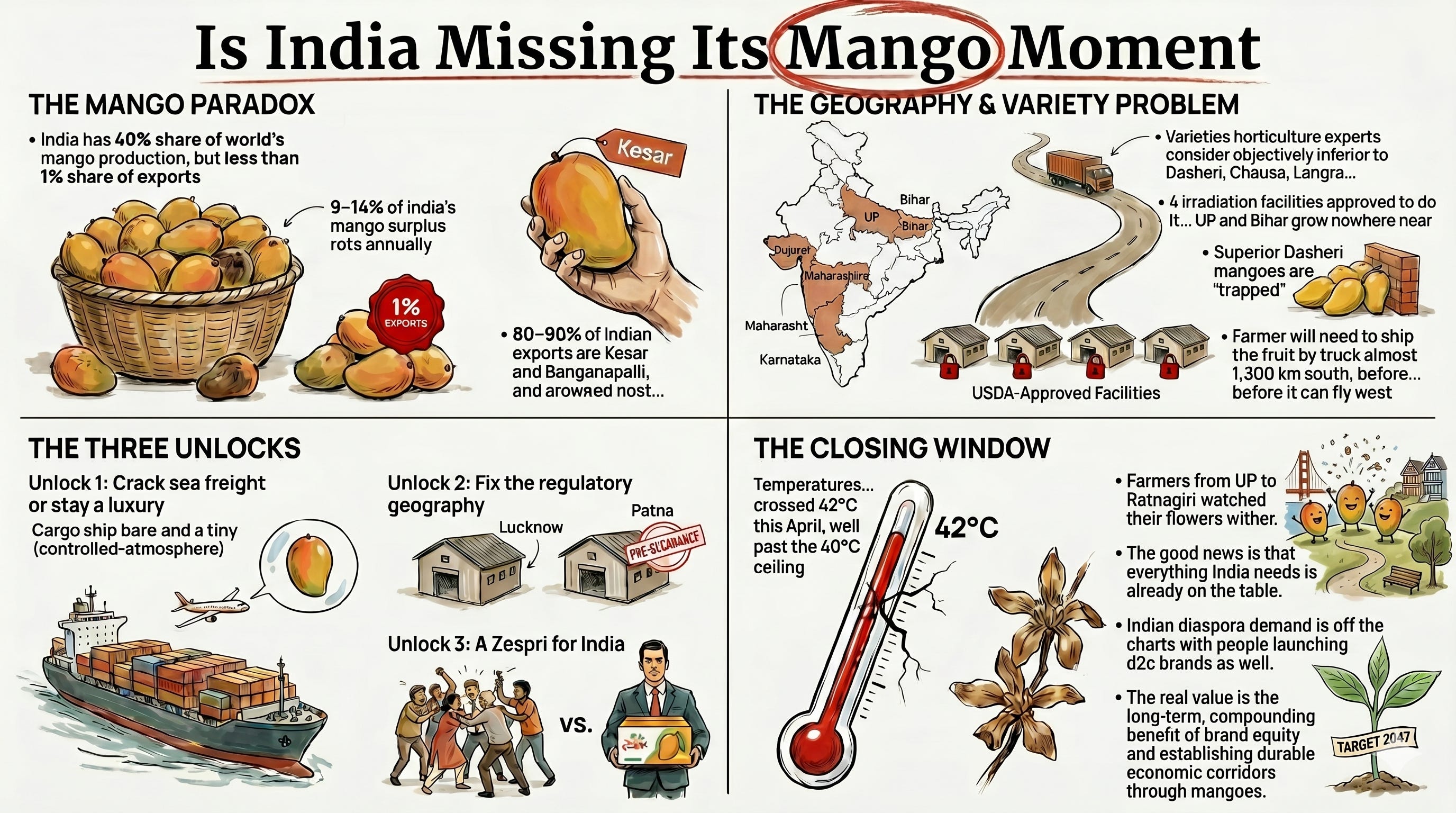
India has 40% share of the world’s mango production, but less than 1% share of exports
9–14% of India’s mango surplus rots annually.
80–90% of Indian exports are Kesar and Banganapalli, varieties horticulture experts consider objectively inferior to the Dasheri, Chausa, Langra grown in UP and Bihar
Mexico, which produces a fraction of India's mangoes, is the largest exporter to the US. Even Peru and Brazil, countries that produce far fewer mangoes than India dominate the global trade.
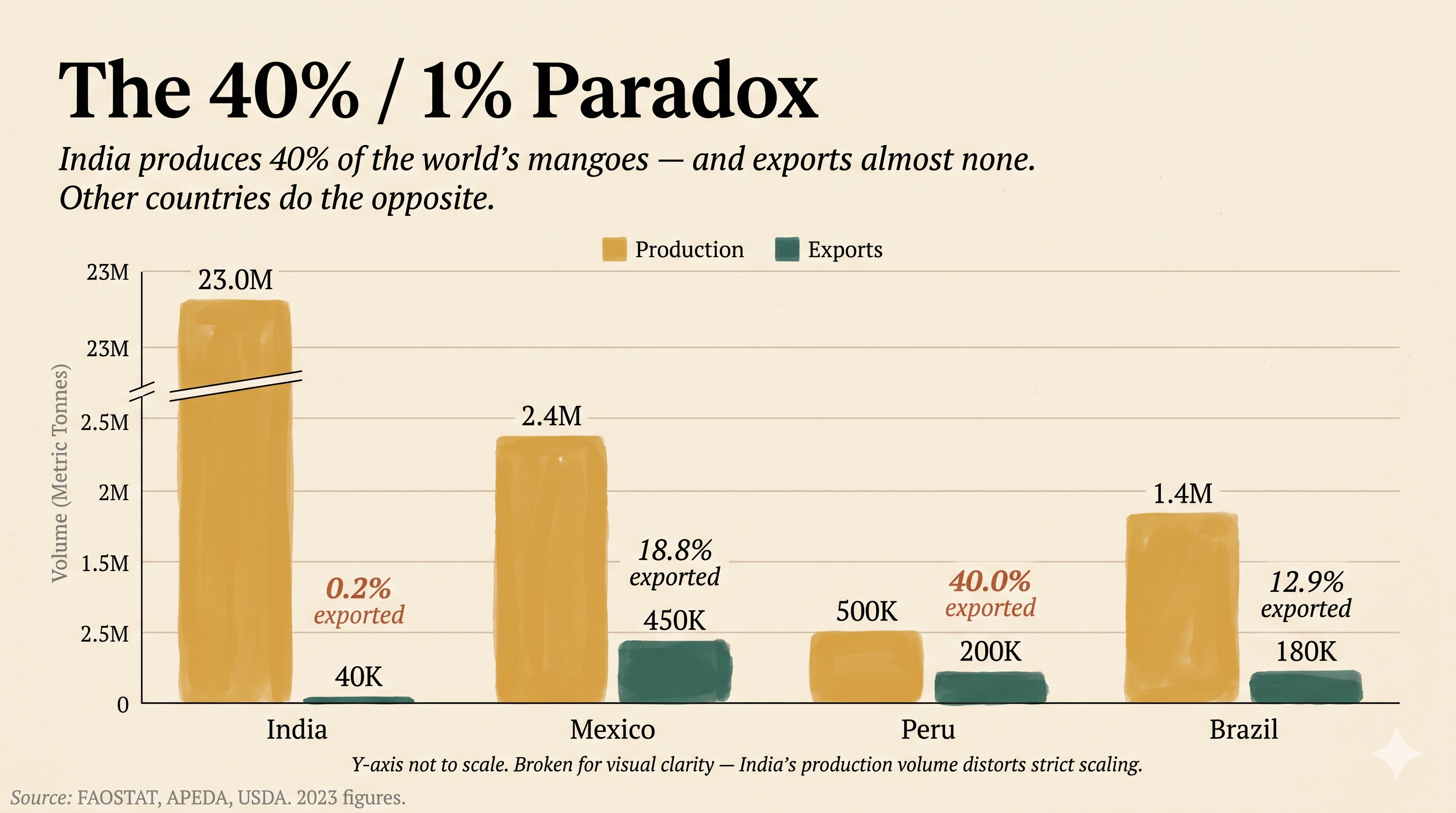
So why does India consistently export its B-Team of Mangoes to the US?
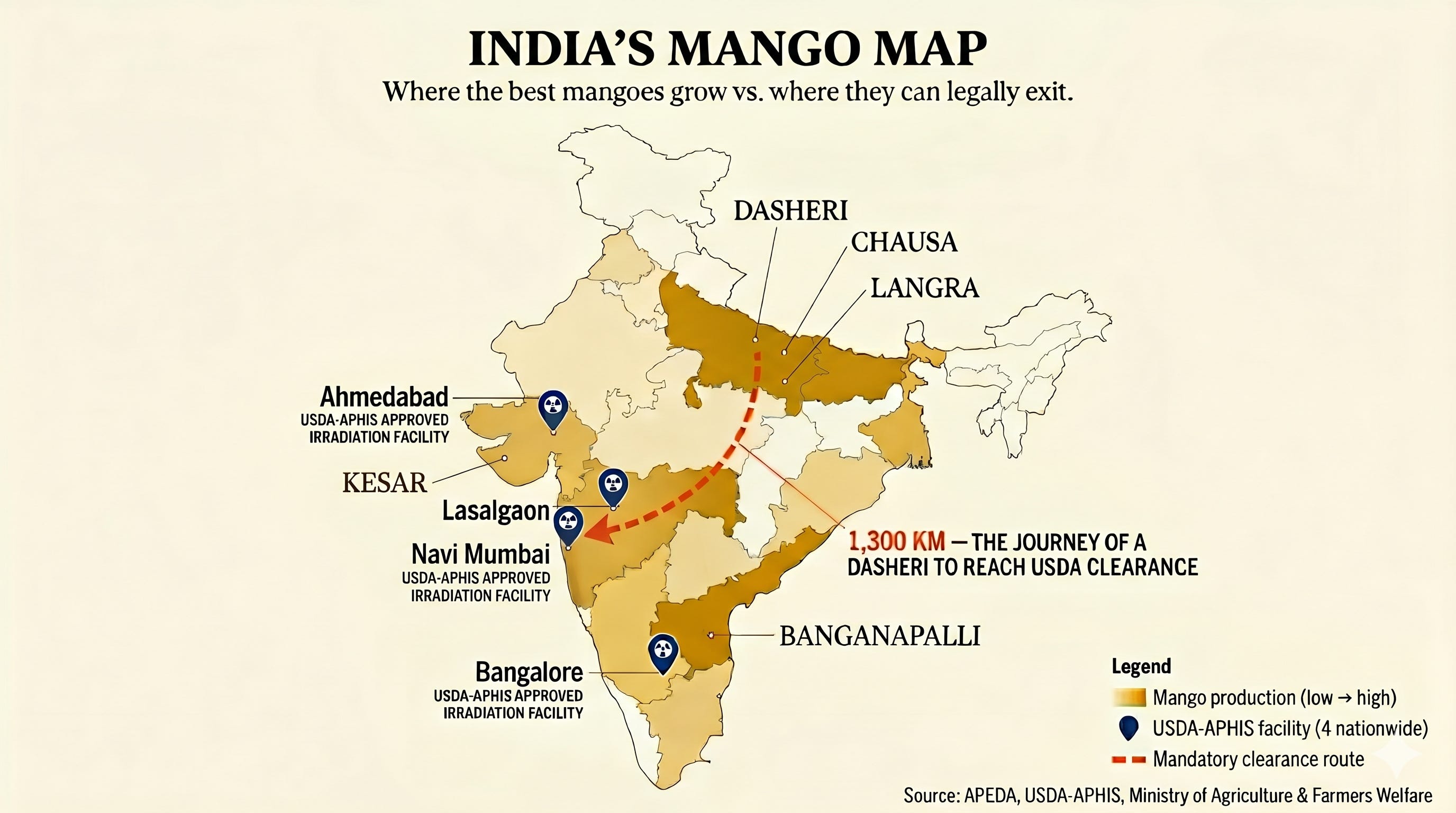
Every mango entering the US has to be sterilized first through gamma irradiation. However, there are only 4 such facilities in India that are USDA approved to do it, one each in Maharashtra, Gujarat and Karnataka. India’s most prized mangoes which include the Dasheri, Chausa, and Langra of UP and Bihar grow nowhere near these facilities.
Now imagine, to export them, a farmer will need to ship the fruit by truck almost 1,300 km south for clearance before it can fly west. So exporters ship what’s closest and readily available and a large variety of great Indian mangoes never see western shelves.
So can India build the irradiation, cold chain, and branding infrastructure close to where its best mangoes actually grow? Norway turned salmon into a $15 billion industry on the back of exactly this kind of build-out. India doesn’t need to turn mango into a diplomatic weapon. The question is whether it can build the corridor to make it matter.
The Precedent Exists to Make Mango a “Wedge”
The best place to find solutions in global trade is often to look at history. Three countries have already solved a version of this problem and made their products unique, geotagged and abundant using a world-class logistical corridor:
Norwegian salmon: Norway built a $15 billion seafood export industry on the back of one fish. It produces more than half of the world’s farmed Atlantic salmon. 95% of Norwegian salmon is exported and United States alone consumes 20% of this. Over the last 20 years, export value of Salmon grew at more than double the rate of volume, rising from $2.1 billion to $12 billion.
Indian shrimp: India doesn’t have to look far for a textbook case-study of infrastructure investment and innovation.
20 years ago, the Indian Shrimp was a footnote, and today it is a $10 billion export powerhouse. Two things drove this growth: the 2009 introduction of the disease-resistant Vannamei shrimp and disciplined USDA/EU compliance. Massive infrastructure investments with a long-term horizon like bio-secure hatcheries, modern feed mills were made and advanced cold-chain networks were established. This booming ecosystem birthed over 60 major corporate giants including listed majors like Avanti Feeds and Devi Sea Foods. Today, shrimp generates 70% of India’s seafood export earnings and sustains 30 million rural livelihoods.New Zealand Zespri: Perhaps the most relevant example of a fruit being geotagged, recognized and available across the world is New Zealand Kiwi. In the late 1980s, kiwi production was very fragmented in a small, remote island far-away from mainland Europe and Asia.
In 1997, the government created a grower-owned single-desk exporter which controls grading, pricing, marketing, R&D and variety development. The result was spectacular ~ NZL Kiwi is today 1% of global fruit volume and is a premium shelf product in over 50 countries. Smart aggregation and export-orientation boosted a NZ$400 million industry to beyond NZ$4 billion today. When a pest wiped out half the orchards in 2010, they established a single-desk coordinated effort for national replanting. A fragmented industry would have collapsed under the same pressure.
There is no mystery about the playbook. India has even run it and reaped the rewards before, on shrimp. The question is why it hasn’t been run on the fruit India is most famous for!
Three unlocks to build the US-India Corridor for Mangoes
If India is serious about taking mango exports from under 1% to the 5% target now sitting in NITI Aayog’s Viksit Bharat 2047 document, three things have to happen in this decade: one in logistics, one in regulation, one in market structure:
Unlock 1: Crack sea freight or stay a luxury
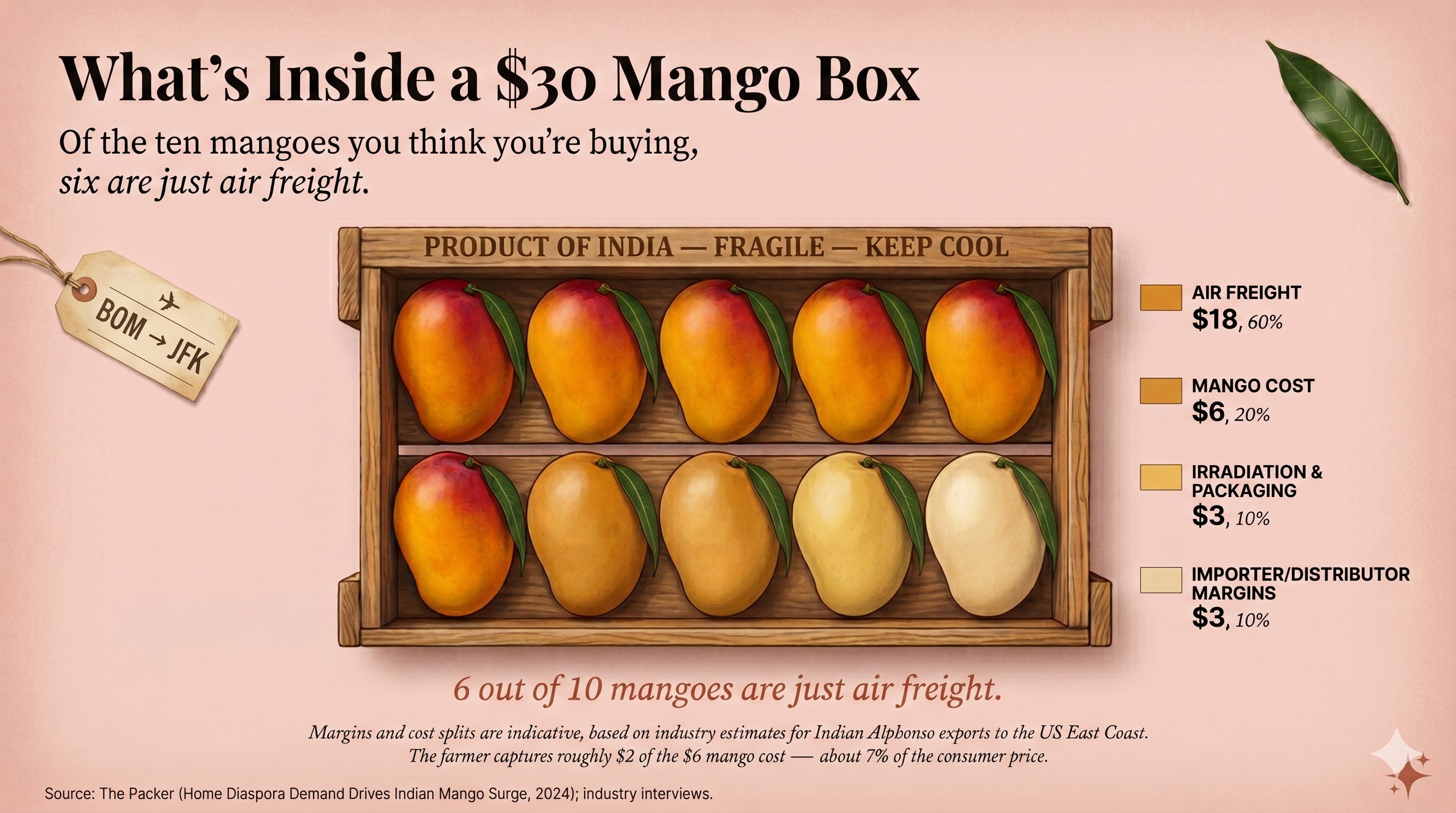
When a $30 box of mangoes lands in New Jersey, $18 of it is air freight. At those prices, mangoes stay either a status or a nostalgia purchase, and status purchases plateau quickly. They will never sit in a local Kroger supermarket in Dallas at a price an average American family pays for fruit.
Mexico ships mangoes to the US by trucks and Peru ships blueberries by sea using controlled-atmosphere containers. Both have built billion-dollar export categories around them.
India has just developed controlled-atmosphere (CA) reefer containers that put mangoes into a kind of suspended state during long sea voyages. Commercial trials have brought freight costs down by 80%. A coordinated pilot between APEDA, MOFPI and the major exporters is needed to make it work for the Indian mango.
Until that happens, the North American demand for mangoes will be capped at 10,000 tonnes, no matter how many mango parties the Indian diaspora throws.
Unlock 2: Fix the regulatory geography
India has 28 irradiation facilities all across the country. Only 4 are USDA-APHIS approved for mango export to the US, all in Maharashtra, Gujarat, and Karnataka. Mangoes that do not pass the irradiation treatment at one of these facilities cannot legally enter the US market.
85% of India’s mango production happens outside these three states and over 43% of India’s mangoes are produced over 700 km away from one of these irradiation centres.
The best varieties (Dasheri, Chausa, Langra) grow in UP and Bihar where northern winter stress before flowering gives them superior aroma and sweetness. Right now, a farmer in Lucknow wanting to export premium Dasheri must truck the highly perishable fruit over 1,300 kilometers southwest to one of the certified facilities.
A simple fix can be establishing USDA-APHIS pre-clearance facilities in Lucknow and Patna. The Indian government has announced Rs. 1,000 crore funding for export infrastructure under the Pradhan Mantri Kisan Sampada Yojana. But the mango-harvest season only lasts for 3 months and a single-purpose hub sitting idle for nine months can be a policy non-starter.
A way to justify the capex is to build these facilities as “multi-commodity” hubs that can process litchi exports (especially in Patna), potatoes, onions, and grains during the mango off-season.
Unlock 3: A Zespri for India
Like in New Zealand before 1997, hundreds of exporters are undercutting each other. The industry standard margin for mangoes is just 5-10%. These are commodity economics for a product the diaspora pays luxury prices for.
The premium is captured by importers and resellers, while the farmers and exporters earn the leftovers.
India needs to take a leaf out of the Kiwi-book by establishing a farmer-organisation owned single-desk body. One body that owns quality standards, international marketing, GI tags, climate-resilient R&D, and ensures price discipline.
It does limit outsized returns for a few large export houses but the upside is a structure that lets a much wider base of farmers participate in the premium. Fragmentation is what kills most agri-exports. India keeps relearning this and yet refuses to act on it.
The Closing Window
India’s mango season is getting shorter. Temperatures across the northern mango belt crossed 42°C this April, well past the 40°C ceiling for healthy fruit development. Farmers from UP to Ratnagiri watched their flowers wither. Every year India waits to fix this corridor, the window for Indian mangoes to claim premium shelf space narrows further.
The good news is that everything India needs is already on the table. The 5% export target is firmly written into the Viksit Bharat 2047 plan, the investment in infrastructure has been announced and the Zespri playbook is now 50 countries deep.
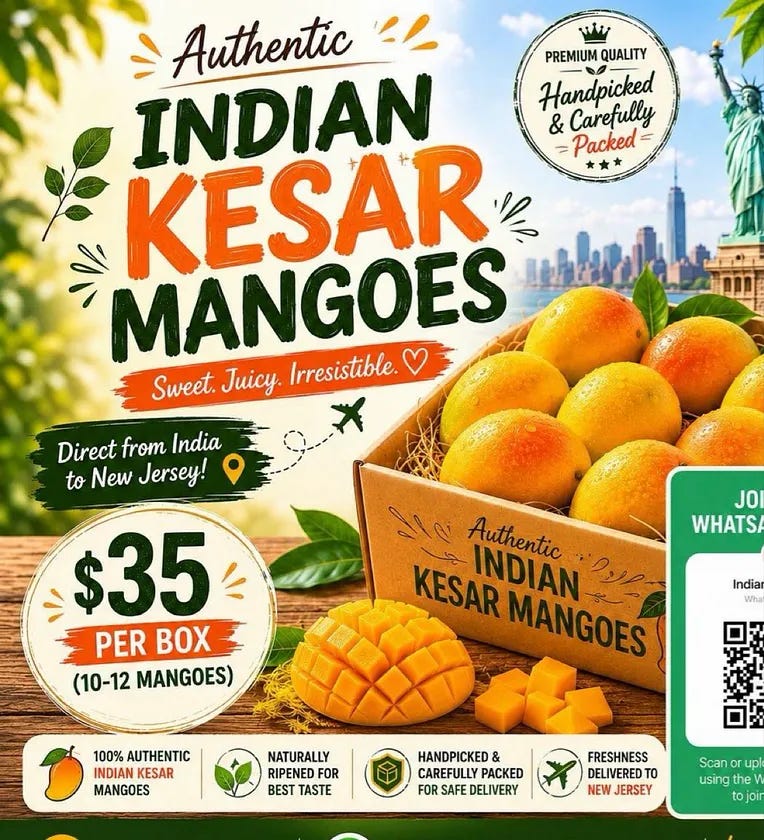
The diaspora demand has been so high that a couple of Indian moms in my apartment’s WhatsApp group have launched a side business reselling mangoes. One of India’s most celebrated chefs, Vikas Khanna launched his own Indian Mango brand last year. The moms on WhatsApp and Vikas Khanna are pointing at the same thing: there’s a market here that traditional export channels haven’t even noticed.
And somewhere in a Costco in New Jersey, a $70 box of Alphonsos is still selling out in hours, telling India exactly what the world is willing to pay for what India already grows better than anyone else.
Mangoes are not soybeans. India cannot squeeze a superpower with a fruit. But, the real leverage is compounding anyway.
Such a corridor outlasts the fruit and the brand equity outlasts the corridor.
Thank you for reading. More of my writings live here, and learn more about me.
My fav piece so far!